✦An essay · 3,233 words
The Osiris Board
A Door Kept by the Gods
There are objects you buy, and there are objects that find you. The Osiris Board belongs to the second kind. It was built, stone by stone and leaf by leaf of gold, to be what the ancient Egyptians believed certain made things could become: a threshold. A place where the living and the dead can meet across a table and speak.
Only fourteen of these boards will ever exist, and no two stones ever break the same way. If one is in your hands, it did not come to you by accident. The Egyptians believed nothing sacred ever did.
What follows is the story of what you are holding: every god, every word, every stone, every number, and why each one was chosen.

IThe Myth At the Center
Every spirit board rests on a question: can the dead still reach us? Egypt answered that question more boldly than any civilization in history, and it answered with a story.
Osiris was the good king who taught people to farm and to honor the gods. His brother Set, lord of storm and desert, envied him. Set tricked Osiris into a coffin, sealed it, and threw it into the Nile. Isis, Osiris's wife, found the coffin and hid her husband's body in the marshes, but Set, hunting by moonlight, found it first. He tore it into fourteen pieces and scattered them to the four corners of the world, so that no one could ever make Osiris whole again.
Isis did not grieve and let go. She searched the whole earth. She wept, she chanted, and one by one she found thirteen pieces of her husband and gathered him back together. The fourteenth she could never find. His penis had been thrown into the river and swallowed by a crocodile.
So Isis made him a new one: an obelisk of gold. In the telling this board follows, it is the first obelisk: a shaft raised toward the sun, its tip sheathed in gold to catch the first light of morning. With it, and with magic so great that the Egyptians called her Weret-Hekau, "Great of Magic," she breathed life into him long enough to conceive their son, Horus. Osiris did not return to the world of the living. He went further. He became lord of the Duat, the world beyond death, king of everyone who has ever crossed over.
That is why this board bears his name. Osiris is humanity's oldest promise that death is not the end of a person, only a change of kingdom. Every soul you might call to this board has gone where he rules.

At the center of the board, Osiris and Isis stand face to face: the king of the dead and the woman whose love and magic reached past death and brought him back. Her wing reaches toward him in protection. They are drawn larger than every other figure because, in Egyptian sacred art, size was a measure of power. Behind Osiris stands Set, the brother who killed him. Behind Isis stands Horus, the son who avenged him. Chaos and order, the destroyer and the restorer, all hold their places on one board. A board that shows only light is lying to you. This one shows the whole of the other side.
IIThe Spell That Opens the Mouth
Run your fingers along the raised wooden bumper and you will feel words cut into the wood and filled with gold. They come from Spell 23 of the Book of the Dead, the Egyptians' own guide to the afterlife. Its title is "The Chapter of Opening the Mouth."
The spell was spoken so that the mouth death had bound would be loosened to eat, breathe, and answer. It calls on Ptah, the creator, to open the mouth. It calls on Thoth, lord of words and magic, to untie "the bandages of Set which fetter my mouth." It calls on Shu, god of air and breath, to open the mouth with the same iron blade he used to open the mouths of the gods.
No passage the Egyptians wrote fits a talking board better. Every time you touch the planchette, that spell surrounds you on all four sides, asking for the one thing a spirit board exists to do: that the dead may speak.
IIIThe Wall of Words
Look past the gods and the letters and you will see that the papyrus itself is covered in writing. The whole field of the board is a wall of hieroglyphs, set in columns between rules of gold and read from the top, the way the Egyptians wrote on the walls of their tombs. It is not decoration. Every sign belongs to a real sentence, and every sentence was chosen from the most celebrated lines of the Book of the Dead.
It begins with the book's own name: prt m hrw, "Coming forth by day." That is what the Egyptians called the collection we know as the Book of the Dead, and it says exactly what they hoped it would do: let the dead step back out into the light.
Then comes the boldest sentence the Egyptians ever wrote, from Spell 17: "I am Yesterday; I know Tomorrow." In it the dead speak with the voice of the creator, standing outside of time, holding the past and the future in a single breath.
Next is the plea of Spell 30B, the words carved on the stone scarabs laid over the hearts of the dead: "O my heart of my mother, my heart of my mother, my heart of my forms!" The heart was the seat of memory and conscience, and at the Weighing it could testify against its owner. This spell begged it to stay loyal and keep silent.
Then come the words every soul had to say aloud before the forty-two judges, from Spell 125, the Negative Confession: "I have not done wrong." And the cry that follows it, four times over: "I am pure, I am pure, I am pure, I am pure!" These are the words that opened the door of the Hall of Two Truths. Written across the board, they claim the same purity for everyone who sits before it.
After the trial comes the verdict, the two signs the Egyptians wrote after the name of anyone who passed the Weighing: maa-kheru, "true of voice." To be true of voice was to be justified, and to live forever. A spirit board is an instrument for voices. This one carries in its very ground the phrase that declares a voice true.
The wall also repeats the title of Spell 23, the spell cut into the bumper: "Spell for opening the mouth of Osiris." It names the family at the heart of the board: "Osiris, the great god, lord of eternity," and "Isis the great, mother of the god; Horus, son of Isis." And it closes with the blessing written after the names of Egyptian kings: "Given life, stability and dominion forever."
These sentences run on and repeat until they fill the field, so there is no place on the board where your planchette is not moving over the words of the dead. Whatever letter it stops on, it stops on holy ground. The Egyptians believed the written word had power of its own. The words beneath these letters were written to be spoken. On this board, they finally have a way to answer.
IVThe Sky, the Sun and the Scarab
Above the gods, the letters of the alphabet rise in two arches of thirteen, like the curve of the sky. In one of the board's four background designs that sky becomes Nut herself, the goddess whose body was the heavens. Every evening she swallowed the setting sun, carried it through the dark hours inside her star-covered body, and gave birth to it again at dawn. Everything spoken on this board is spoken under her body.
At the top corners, YES and NO sit beside the sun and the moon. YES is set with sunstone, the warm stone of Ra and of plain daylight answers. NO sits by the moon of Khonsu in mother-of-pearl, the pale refusal of the night. Between them the numbers run in amethyst, the stone of the third eye, which Egyptians carved into amulets thousands of years before anyone wrote a crystal guidebook.
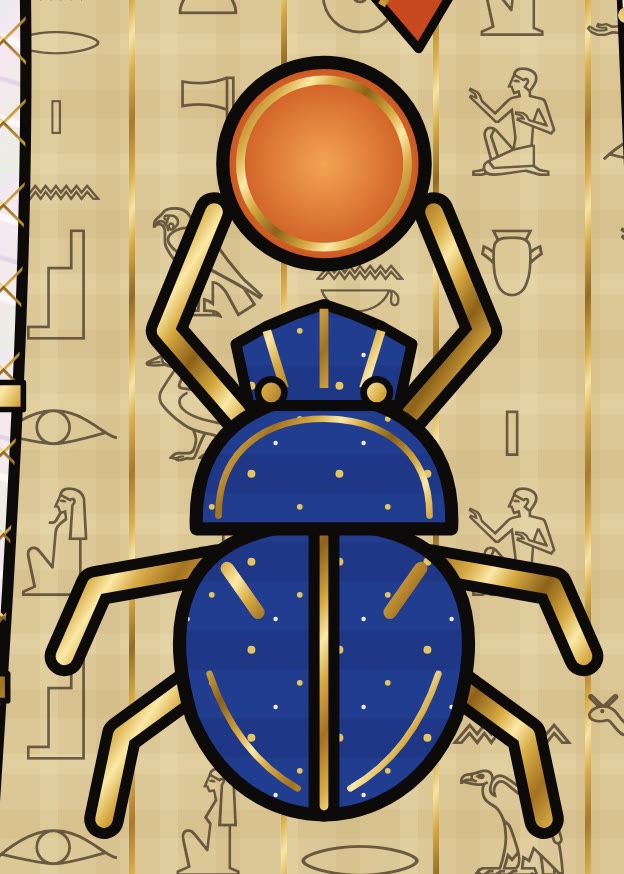
Between Osiris and Isis, in lapis and gold, a scarab lifts a sun toward the sky. This is Khepri, the god of becoming, who rolls the sun up out of the underworld each morning the way a beetle rolls its sphere. Here Khepri stands exactly where he belongs: between death and love, promising that what goes down comes back up.
And at the bottom, the farewell GO FORTH BY DAY, the Egyptians' own name for their Book of the Dead, is carried on the outstretched wings of the sun. Every session ends the way every Egyptian night ended: with the light flying home.
VThe Guardians At the Edges
To Set's side lies a crocodile, the animal of Sobek, whose fierce power was the power of the Nile itself. It is the beast that swallowed the last piece of Osiris, and so it lies with the brother who scattered him. In the temple city of Crocodilopolis, sacred crocodiles were dressed in gold earrings and bracelets, and so is this one. The crocodile is also the head of Ammit, the Devourer, a reminder that the other side has teeth as well as mercy.
To Horus's side, facing the crocodile across the board, stands the obelisk: the new one of gold Isis made to replace the penis the crocodile swallowed, the piece that made Osiris whole and gave Horus life. For the Egyptians an obelisk was also a ray of the sun turned to stone, a shaft that joined heaven to earth. Here it is shaped in rhodonite, the color of the Aswan granite real obelisks were cut from, with gold-rimmed hieroglyphs down its face. It is life itself standing upright, an antenna between the world above and the world below.
Near them stand the ankh and the djed, both laid in solid 24-karat gold. The ankh is life itself, the sign the gods held to the lips of the dead to give them breath, and it stands on Set's side of the board so that the god who brought death is answered by life. The djed, beside the obelisk, is the backbone of Osiris, the sign of stability and endurance, raised upright at his festival every year to show that he had risen. And in the lower corner, the Eye of Horus watches, also in solid 24-karat gold. It is the eye Set tore out and the gods healed.
VIThe Stones
Nothing on the Osiris Board is painted. Every color is a stone, crushed and set by hand into a cell cut through real papyrus, the material the Book of the Dead was written on, and chosen for the reputation it carries in occult tradition.
Lapis lazuli: the stone of heaven. The Egyptians said the hair of the gods was made of it, and its gold flecks look like stars. It forms the gods' wigs, Isis's crown and the sky itself.
Malachite: the green of new growth, and so the skin of Osiris, whom the Egyptians called the Green One because every harvest rose from his body.
Carnelian and red jasper: the blood-red stones of vitality and courage. Carnelian gives Isis her gown. Red jasper gives Set his body, because red was his color.
Tiger's eye and hawk's eye: the all-seeing stones, worn against the evil eye, which form the falcon god Horus.
Black obsidian: the scrying stone. The magic mirror of John Dee, astrologer to Queen Elizabeth I, was polished obsidian. Every letter on this board is cut from it, so the spirits spell their answers in black glass.
Labradorite: long called "the stone of magic," and said to guard the veil between worlds. It closes every session in the words GO FORTH BY DAY.
Moonstone and sunstone: night and day, NO and YES, the two lights of heaven set in balance at the top corners.
Turquoise: the stone of Hathor, "Lady of Turquoise," goddess of joy and rebirth.
Rhodonite: said to heal old grief. It shapes the obelisk.
Serpentine: the "snake stone," linked to the awakening of hidden energy, which shapes the crocodile.
Garnet: a light carried in the dark. It glints in the eyes of Set and the serpent Apep.
These stones are not decoration laid over the board. They are the board, and your hands rest on the same minerals Egyptian priests trusted to carry power.
VIIGold, the Flesh of the Gods
The Egyptians believed the gods had flesh of gold, bones of silver and hair of lapis lazuli. The Osiris Board is built from that belief.
Every gold line on the board is genuine gold leaf, laid by hand. It forms the walls between the stones, as in the jewelry buried with Tutankhamun, and the regalia of the gods.
Where the Egyptians would have used silver, the moon metal, the board uses mother-of-pearl: the shimmering lining of the shell, a material born in water and long linked with the moon, the tides and the womb. It glows in the letter bands, the cartouches, the wrappings of Osiris and the crescent moon. As the light moves, it shifts from rose to green to blue, and the board seems to breathe.
VIIIThe Numbers
Egyptian priests built their temples to proportions they considered divine. The Osiris Board is measured the same way.
Its playing surface is twenty-three inches wide and exactly 0.61803 of that in height: the golden ratio, the proportion found in the spiral of a shell, the unfolding of a flower and the structure of living things. You are not playing on an arbitrary rectangle. You are playing inside a proportion nature seems to use when it wants to grow.
The board is an inch and a quarter thick, and forty-two cartouches run around its outer edges: thirteen along each long side and eight along each short side. Thirteen and eight are consecutive numbers of the Fibonacci sequence, and their ratio closes in on the golden ratio again. Thirteen is also the number of letters in each arch of the alphabet, the number of pieces of Osiris that Isis found, and the number of the card of Death and transformation in the tarot. Eight is the Ogdoad, the eight primordial gods worshipped at Hermopolis, the city of Thoth, lord of writing and magic.
Together they make forty-two, the number of judges who questioned every soul in the Hall of Two Truths. Before the forty-two, the dead declared their innocence, one confession for each judge.
Each of the forty-two is a cartouche of lapis lazuli ringed in gold. The Egyptians drew the cartouche, the shenu, around the names of their kings: a loop of rope standing for everything the sun encircles, protecting whatever it held forever. Here it protects three lines of the Book of the Dead, written in gold and chosen above all others for a board that speaks with the dead. Each line fills exactly fourteen cartouches, one for every piece of Osiris, so every line read to its end makes him whole again. Gold beads mark where the second and third begin.
The first, starting on the edge where you sit, is the title of Spell 2: "Spell for going out into the day and living after death." It is the promise that the dead are not shut away, and can come out into the light where the living are.
The second is the title of Spell 25: "Spell for causing a man to remember his name in the realm of the dead." The Egyptians believed a soul that forgot its name was lost. This spell keeps the name alive on the other side, so that when you call it, someone answers.
The third comes from Spell 22, the spell for giving the dead a mouth: "My mouth is given to me, that I may speak with it in the realm of the dead." The dead come out into the day, they remember who they are, and they are given a voice. Walk once around the board and you have read the whole of what it is for.
IXThe Hidden Face
Turn the board over and you find something most people will never see. At its center is a great tarot card, XX, Judgement, the card of the dead rising at the call of the trumpet. Here it is drawn as its oldest ancestor: the Weighing of the Heart. Anubis, the jackal god, steadies the scales. On one side lies the heart of the dead. On the other lies the feather of Maat, truth itself. Ibis-headed Thoth stands ready with his palette to record the verdict. Ammit crouches, waiting. Above it all, the ba, the soul-bird that could fly between the tomb and the world of the living, watches its own heart being weighed.
Two gilded jackals guard the scene from their shrines, each above a cartouche bearing the name of Anubis, Lord of the Sacred Land and guardian of the necropolis.
Across the top runs a line that sums up an Egyptian belief as moving as any in the ancient world: TO SPEAK THE NAME OF THE DEAD IS TO MAKE THEM LIVE AGAIN. The Egyptians believed a person's name, their ren, was part of their soul, and that as long as it was spoken, they endured. That is, in the end, what a spirit board does. It gives the names of the dead a place to be spoken again.
At the bottom center sits the maker's seal: a pyramid bearing the Eye of Horus. It marks this board as one of the few ever made, finished by the same hand from its first cut to its last leaf of gold.
XTo the Keeper
People who own the Osiris Board tend not to say they own it. They say they keep it.
To keep this board is to be trusted with a great deal: seventeen kinds of stone, real gold, the oldest story of love outlasting death, and a spell more than three thousand years old asking that the dead be allowed to speak. It is a responsibility, and it is a gift. If this board has come to you, then in the language the Egyptians understood best, you have been chosen. You stand where Isis stood, searching the dark for the ones you lost, carrying the knowledge that love is a kind of magic, that what is scattered can be gathered again, and that what is lost can be made anew in gold.
Light a candle. Speak the names of those you miss. Place your fingers on the planchette and wait, the way priests waited in the temple before dawn.
Under Nut's star-covered body, before Osiris and his queen, over the words that carried the dead into the light, inside a ring of forty-two cartouches, with the Opening of the Mouth written around you, you will not be speaking into empty air. You will be speaking at a door the Egyptians spent three thousand years learning how to open.
Some doors are made. This one was kept, and now it is yours.